
Why Low-Morale Teams Are a Motivation Problem — Not a People Problem
Organizations facing low morale often search for immediate solutions to re-engage their workforce. Many default to increasing incentives, introducing new performance structures, or tightening accountability measures. However, these approaches frequently produce inconsistent results, especially in environments where financial rewards or disciplinary leverage are limited. This is where a deeper understanding of human motivation becomes essential.
I am Seth Yelorda, a Keynote speaker, Coach, and Consultant and this is exactly the type of challenge I work through with corporate leaders every day. With over 15 years of senior leadership experience, I help leaders Lead with Clarity by helping organizations move beyond surface-level tactics and into the psychology that actually drives behavior. One of the most effective frameworks I use is the self-determination continuum. This model explains not only how motivated someone is, but why they are motivated. That distinction is critical because two employees can demonstrate the same level of effort while being driven by entirely different internal forces.
For organizations that do not have a large budget for bonuses or incentives, this insight becomes even more valuable. When external rewards are limited, I work with leaders to activate internal motivation. At Vision Clarity, I emphasize that long-term engagement is not built on compensation alone. It is built on meaning, autonomy, and alignment with purpose.
What the Self-Determination Continuum Actually Explains
The self-determination continuum is a framework that categorizes motivation along a spectrum ranging from completely external to fully internal. At one end, individuals act purely to gain rewards or avoid punishment. At the other end, they act because the work itself is meaningful and aligned with their identity.
When I work with leadership teams through Vision Clarity, I make it clear that motivation is not simply present or absent. It exists in degrees and types. External motivation includes behaviors driven by bonuses, recognition, or fear of consequences. While these can produce short-term results, they rarely create lasting engagement. Internal motivation, by contrast, is driven by purpose, personal values, and a sense of ownership. This type of motivation is far more resilient, particularly during periods of stress or organizational change.
I use this continuum as a practical tool with leaders. It allows us to identify where their teams currently operate and where they need to move. Instead of asking why employees are not working harder, I guide leaders to ask what type of motivation is driving behavior. That shift changes how leaders communicate, set expectations, and shape culture.
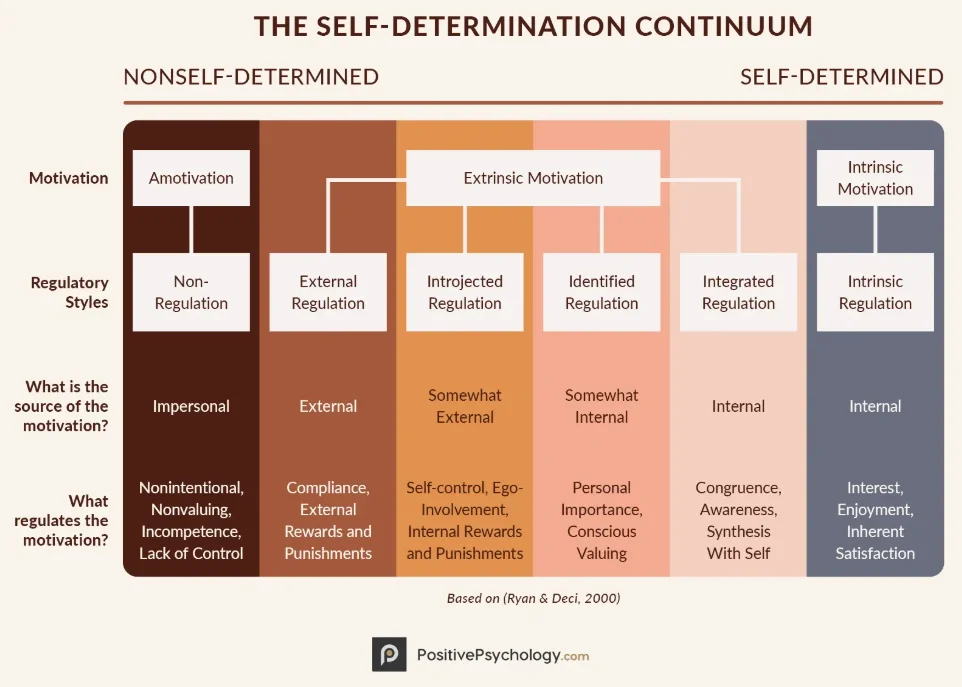
The Different Types of Motivation Within the Continuum
One of the most important insights I share at Vision Clarity is that not all motivation is equal. Even within externally driven behavior, there are different levels of internalization, and that is where many organizations misinterpret what they are seeing.
At the most external level, individuals act to avoid punishment or gain a reward. This is external regulation. Slightly more internalized is introjected motivation, where individuals act out of pressure, guilt, or the need to protect their self-image. While this can appear as commitment, it often leads to burnout because it is not rooted in genuine alignment.
Further along the continuum is identified motivation. In this stage, individuals recognize the value of their work, even if they do not fully enjoy it. They understand its importance and choose to engage. At the highest level is intrinsic motivation, where individuals perform tasks because they find them inherently meaningful and satisfying.
I often explain to leaders that two employees can complete the same task at the same level of quality, yet one may be operating from pressure while the other is driven by purpose. The short-term results may look identical, but the long-term sustainability of that performance is very different. At Vision Clarity, I help organizations recognize these differences so they can build teams that are both productive and engaged.
Why External Incentives Often Are Not Enough
Many corporate leaders have been conditioned to believe that motivation is primarily driven by compensation. While financial incentives do play a role, I consistently see them overused as a solution to deeper cultural challenges. This becomes especially problematic in organizations that do not have the flexibility to offer significant raises, bonuses, or other financial rewards.
In my work with Vision Clarity, I often partner with organizations operating under budget constraints, union regulations, or rigid compensation structures. In these environments, leaders quickly realize that they cannot rely on a bag of money to drive performance. That realization forces a more strategic and sustainable approach.
Instead of focusing on external rewards, I guide leaders to strengthen internal drivers. When employees understand how their work connects to a larger mission, they begin to find meaning in what they do. When they are given autonomy and trust, they develop a sense of ownership. When their contributions are recognized in meaningful ways, their connection to the organization deepens.
External incentives may create temporary increases in performance, but they rarely build lasting engagement. Internal motivation creates consistency. It drives individuals to maintain high standards even when no immediate reward is present. That is the type of motivation I focus on building at Vision Clarity.
Activating Internal Motivation in Corporate Environments
Promoting internal motivation demands purposeful leadership. It is not the result of a single program or message but emerges from the steady alignment between an organization’s words and the behaviors it consistently supports.
At Vision Clarity, I begin with clarity. Employees must understand the organization’s mission, vision, and values, and more importantly, how their individual roles contribute to those elements. Without that connection, work feels disconnected and transactional.
I also focus heavily on autonomy. Employees need to feel a level of control over how they approach their work. This does not mean removing structure or accountability. It means creating space for ownership and initiative. When individuals feel trusted, their engagement increases significantly.
Competence is another critical factor. People are more motivated when they feel capable and supported in their roles. This requires ongoing development, clear feedback, and opportunities to grow. At Vision Clarity, I work with leaders to create environments where employees can build confidence in their abilities.
Connection is equally important. Employees want to feel that they are part of something meaningful and that their work matters to others. I help organizations strengthen this sense of connection by reinforcing shared purpose and building stronger team dynamics.
The Leadership Shift Required to Sustain Motivation
Understanding the self-determination continuum is only the starting point. The real impact comes from how leaders apply it in their day-to-day leadership.
In my work with Vision Clarity, I emphasize that leaders must shift from controlling behavior to influencing mindset. This means moving beyond simply assigning tasks and measuring outcomes. It requires creating an environment where the right type of motivation can develop.
Leaders must also be consistent. Internal motivation cannot grow in an environment where expectations are unclear or leadership behavior is inconsistent. Employees need to see alignment between what is stated and what is practiced. When that alignment exists, trust strengthens and engagement follows.
When organizations commit to this approach, I consistently see a shift in both performance and culture. Teams become more proactive, more collaborative, and more resilient.
Applying the Continuum to Low Morale Teams
Low morale teams often operate at the lowest end of the self-determination continuum. Employees may be doing the minimum required, driven primarily by external pressure or job security. In these situations, traditional motivational strategies tend to have limited impact.
When I engage with these teams through Vision Clarity, my approach is to gradually move them along the continuum. This is not an immediate transformation. It requires consistent leadership and intentional effort.
I begin by helping employees understand the purpose behind their work. As they begin to see its value, their motivation becomes more internalized. From there, leaders can reinforce positive behaviors, create opportunities for ownership, and build momentum.
Progress is not always linear. There can be setbacks, especially in high-pressure environments. However, with consistency and clarity, teams can move toward more sustainable and meaningful forms of motivation.
Frequently Asked Questions
Organizations exploring the self-determination continuum often have practical questions about how to apply it effectively. In my work with corporations, these are some of the most common concerns I address.
How can I identify what type of motivation is driving my team? I encourage leaders to observe behavior and ask thoughtful questions. If employees are primarily focused on rewards or avoiding consequences, their motivation is likely external. If they speak about purpose, growth, or impact, their motivation is more internal. Regular one-on-one conversations are one of the most effective ways to gain this insight.
What if my organization has relied on incentives for years? You do not need to eliminate incentives entirely. Instead, I recommend balancing them with internal drivers. At Vision Clarity, I help leaders reinforce purpose, increase autonomy, and align work with values. Over time, this creates a shift toward more sustainable motivation.
Can internal motivation be developed in disengaged teams? Yes, but it requires patience and consistency. I focus on rebuilding trust, clarifying expectations, and helping employees reconnect with purpose. Small, consistent actions are far more effective than large, one-time initiatives.
How does this approach work in structured corporate environments? In highly structured environments, this approach is often even more effective. When compensation and disciplinary options are limited, internal motivation becomes essential. By focusing on clarity, autonomy, and connection, leaders can significantly improve morale without relying on external incentives.
Organizations that understand and apply the self-determination continuum gain a meaningful advantage. Through my work at Vision Clarity, I help leaders move beyond temporary solutions and build a foundation for long-term engagement, stronger culture, and sustained performance.
Lead With Clarity. Partner With Seth Yelorda.
Engaging a team with low morale is not about a single initiative or quick fix. It requires steady, purposeful effort—actions that cultivate trust, clarify expectations, and help employees see the meaningful impact of their work.
At Vision Clarity, I guide organizations through this process, helping leaders create environments where motivation and alignment can thrive. Each keynote and program I deliver is designed specifically for the organization’s culture, goals, and challenges. With over fifteen years of experience in senior leadership, I focus on strategies that produce measurable results while supporting sustainable growth.
If you are ready to move beyond temporary solutions and build a team culture rooted in clarity, accountability, and purpose, I am ready to partner with you to make it happen.
Don’t settle for a generic presentation—bring a speaker who will inspire your team to see the future, understand their role in it, and take action with purpose. Book Seth Yelorda today and give your organization the momentum it needs to achieve extraordinary results. Contact Seth now to secure your event.
Achieve transformational growth with our leadership development programs