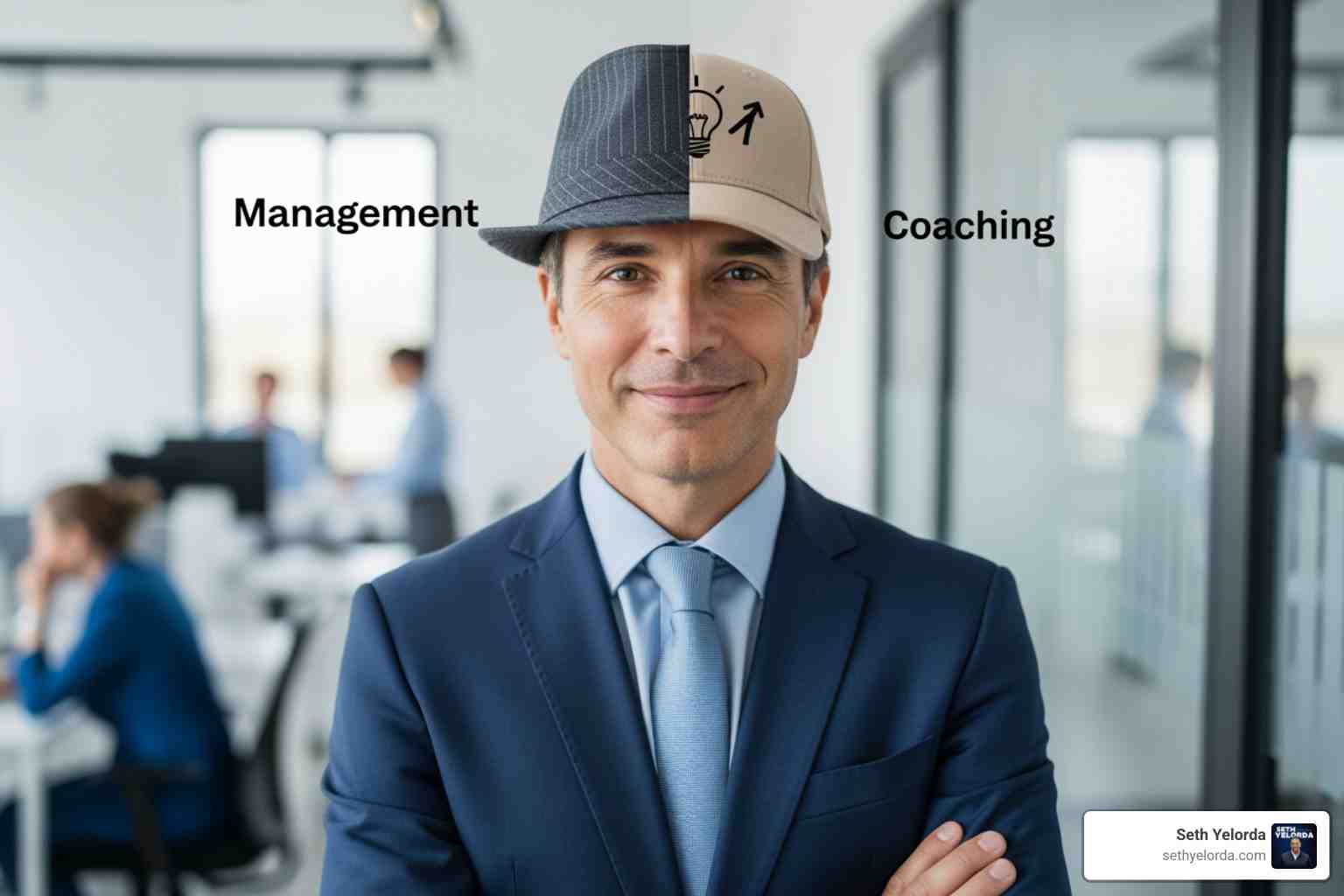
Why Today’s Leaders Need to Master Both Performance and Potential
Managing performance focuses on outcomes—tracking metrics, correcting behavior, and ensuring expectations are met. It’s essential for maintaining standards and delivering results, especially in fast-paced or high-accountability environments. But performance management alone often keeps leaders focused on what’s happening now, rather than what’s possible next. When leaders rely solely on managing performance, they may achieve short-term wins while unintentionally limiting long-term growth.
Coaching potential, on the other hand, shifts the focus from results to people. It’s about developing capability, strengthening self-awareness, and helping individuals think more critically, confidently, and independently. Leaders who coach don’t just fix problems—they expand capacity. By investing in potential, leaders create teams that are more engaged, adaptable, and prepared to perform at a higher level over time, not because they’re being managed, but because they’re being developed.
Here’s the quick breakdown:
| Managing Performance | Coaching Potential |
|---|---|
| Focus: Current tasks and goals | Focus: Future growth and capabilities |
| Approach: Directive and structured | Approach: Collaborative and exploratory |
| Goal: Efficiency and accountability | Goal: Development and empowerment |
| Question: “What needs to be done?” | Question: “How can you grow?” |
| Timeline: Short-term results | Timeline: Long-term investment |
The challenge? Most leaders were promoted for executing tasks, not developing people. Research shows that 57% of middle managers struggle with fundamental leadership capabilities, often lacking formal training. They spend just 41% of their time on people management, buried in administrative work. Yet managers account for 70% of the variance in employee engagement, making this gap between managing and coaching a critical issue for organizations.
The reality is simple: you need both. Managing without coaching creates compliant but disengaged teams. Coaching without managing leads to inspired people who miss deadlines. Effective leadership isn’t choosing one over the other—it’s knowing when to wear which hat.
I’m Seth Yelorda, Founder of Vision Clarity Consulting. My 15+ years of senior leadership experience show that understanding The Difference Between Managing Performance and Coaching Potential is what turns good managers into great leaders. Let’s explore how to integrate both approaches to drive results and develop the people who will take your organization to the next level.
The Difference Between Managing Performance and Coaching Potential
In today’s evolving leadership landscape, managing performance and coaching potential are often used interchangeably—but they represent two very different approaches to leading people. While both are important, understanding how they differ can fundamentally change the way leaders develop their teams. For leaders in Chicago, California, and across the U.S., recognizing the distinction is essential to building high-performing, engaged teams that don’t just meet expectations, but grow beyond them. Managing performance focuses on outcomes, metrics, and accountability; coaching potential looks ahead, unlocking capability, confidence, and long-term growth. The most effective leaders know when to apply each—and how to intentionally shift from one to the other to elevate both people and results.
What is Performance Management?
Performance management ensures current tasks are completed efficiently. It’s a structured, present-focused approach that aligns individual efforts with organizational goals. Key concerns include:
- Task Completion and Key Performance Indicators (KPIs): Setting clear, measurable goals and tracking progress against them.
- Efficiency and Accountability: Ensuring work is done on time and to the required standard, holding individuals accountable for results.
- Setting Clear Expectations: Defining roles, responsibilities, and expected outcomes to remove ambiguity.
- Correcting Deviations: Identifying when performance falls short and implementing corrective actions like direct feedback or retraining.
Performance management is about the “what” and “how well” of right now. It establishes order, ensures smooth operations, and achieves immediate business goals. This approach is vital for productivity and hitting short-term targets. For more on this, explore our article on From Output to Outcomes: How Mid-Level Managers Become Strategic Leaders.
What is Potential Coaching?
Potential coaching is a forward-looking approach focused on an employee’s long-term growth and capabilities. It’s about open uping future possibilities. When coaching, we aim to:
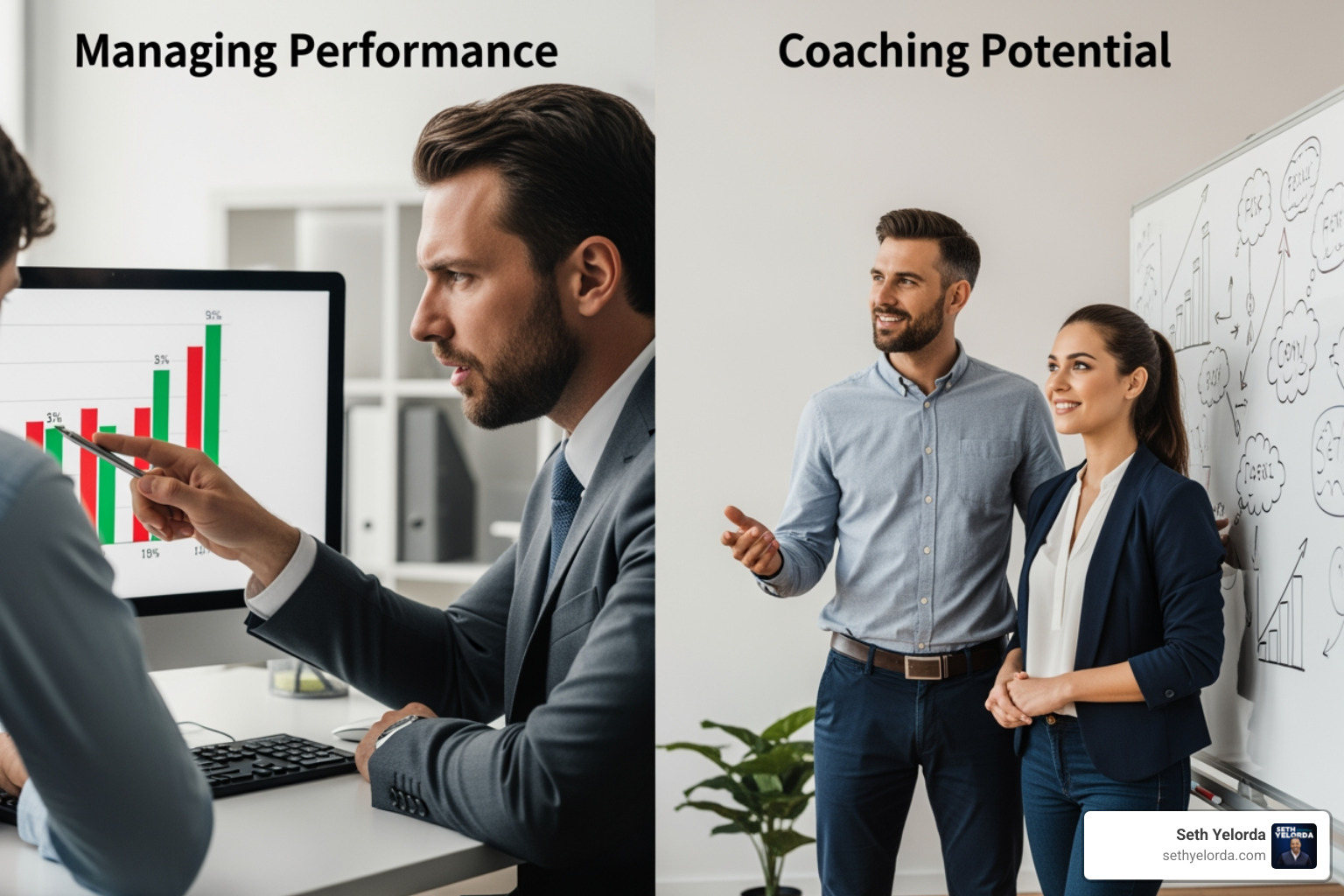
- Focus on the Future and Long-Term Growth: Guiding individuals to identify aspirations, develop new skills, and steer their career journeys.
- Skill Development and Empowerment: Helping employees find their own solutions, take ownership of their development, and build confidence.
- Self-Findy and a Growth Mindset: Encouraging curiosity, experimentation, and continuous learning, reframing challenges as growth opportunities.
- Building Trust and Psychological Safety: Creating a safe environment to express ideas, take risks, and learn from mistakes without fear.
Two Conversations, Two Outcomes: Managing Performance vs. Coaching Potential
Every leader has conversations about performance—but not every conversation builds potential. In practice, managing performance and coaching potential show up very differently in the way leaders communicate, listen, and respond. One conversation focuses on results, expectations, and course correction; the other invites growth, ownership, and forward momentum. Understanding the difference between these two leadership conversations—and knowing when to use each—is what separates managers who maintain performance from leaders who develop people. This distinction plays out not in theory, but in real, everyday interactions that shape trust, engagement, and long-term success.
To see the difference in action, imagine an employee, Alex, misses a critical project deadline.
The Management Approach:
A manager focused on performance would say:
“Alex, the Q3 report was due yesterday. What happened? What are you doing to ensure this doesn’t happen again? We need this submitted by end of day, no exceptions.”
This approach is direct and problem-focused, ensuring immediate accountability. The goal is task completion and preventing recurrence. It’s about the “what” and “when.”
The Coaching Approach:
A leader focused on coaching would ask:
“Alex, I noticed the Q3 report wasn’t submitted. I’d like to understand what challenges you faced. What did you learn from this, and what strategies could you use next time to meet a tight deadline?”
This approach is inquisitive and developmental. The leader helps Alex find the root cause, learn from the experience, and develop new strategies. It’s about the “how” and “why,” fostering self-awareness and future capability.
While both conversations address the deadline, their intent and impact differ. Management gets the report done; coaching helps Alex grow as a professional.
The Situational Leader: When to Manage and When to Coach

Effective leadership isn’t about being solely a manager or solely a coach; it’s about being a situational leader who knows when to apply each approach. This requires astute situational awareness and leadership agility. We must be able to put on the “manager” hat or the “coach” hat as the context demands.
Scenarios for a Management Approach
There are times when a directive, performance-focused approach is not just appropriate, but essential. These are typically situations where clarity, speed, compliance, or immediate results are paramount.
- Crisis Management: In an emergency or critical situation, clear directives are necessary. There’s no time for collaborative exploration; immediate action is required.
- Urgent Deadlines: When a project is behind schedule and an immovable deadline looms, leaders must step in to delegate tasks, reallocate resources, and ensure completion.
- New Employee Onboarding: While coaching plays a role in long-term integration, new hires initially need clear instructions, defined processes, and explicit expectations to learn the ropes and become productive.
- Addressing Clear Underperformance: When an employee consistently fails to meet basic job requirements or violates company policies, a direct management approach is needed to address the issue, set a performance improvement plan, and ensure compliance. This is where clarity on what needs to change is non-negotiable. Sometimes, what appears to be underperformance is actually a Communication Blind Spot – a lack of clarity in expectations or understanding.
- Ensuring Compliance: In matters of legal or regulatory compliance, there’s little room for interpretation. Leaders must ensure strict adherence to rules and procedures.
- Task Delegation: For routine tasks where the “how” is well-established, a manager simply assigns the task and expects completion.
In these scenarios, managing takes precedence. It provides the necessary structure, clarity, and accountability to keep the organization running smoothly and effectively.
Scenarios for a Coaching Approach
Conversely, there are situations where a coaching approach yields far greater long-term benefits, fostering growth, innovation, and engagement. These are typically situations where personal development, problem-solving, and empowerment are the primary objectives.
- Career Development: When an employee expresses interest in advancing their career or developing new skills, coaching helps them explore options, set goals, and create a development plan.
- Fostering Innovation: To encourage new ideas and creative solutions, leaders coach by asking open-ended questions, encouraging experimentation, and creating a safe space for brainstorming and risk-taking.
- Empowering High-Potentials: For employees with significant growth potential, coaching helps them stretch beyond their comfort zones, take on greater responsibilities, and refine their leadership capabilities. This is where we help them Master the Hidden Side of Leadership: Influence, Alignment, Energy.
- Building Problem-Solving Skills: Instead of providing solutions, a coach guides employees to analyze problems, explore alternatives, and arrive at their own effective solutions, building their critical thinking.
- Improving Team Collaboration: Coaching can help team members understand each other’s perspectives, resolve conflicts constructively, and work more effectively together by fostering empathy and open communication.
In these contexts, coaching cultivates a culture of perpetual learning and empowerment, leading to increased self-awareness, improved communication skills, and a better ability to control emotions, as noted in the research on executives who received coaching.
TABLE: When to Manage vs. When to Coach Across Different Business Scenarios
| Scenario | When to Manage | When to Coach |
|---|---|---|
| Project Behind Schedule | Direct task reallocation, set new immediate deadlines, monitor closely. | Explore root causes of delays, help employee develop time management skills for future. |
| New Team Member | Provide clear job description, explain procedures, set initial performance targets. | Discuss career aspirations, identify learning styles, mentor for long-term integration. |
| Employee Underperforming | Set clear performance improvement plan, define consequences, mandate training. | Explore obstacles to performance, help identify skill gaps, guide self-correction. |
| Strategic Planning | Define organizational vision and goals, set department-level objectives. | Facilitate team discussions on innovative approaches, empower team members to contribute ideas. |
| Conflict Resolution | Mediate and set ground rules for discussion, enforce company policy if needed. | Guide individuals to understand perspectives, help develop conflict resolution skills. |
| Skill Development | Assign required training, monitor completion, assess new skill application. | Help employee identify desired skills, explore learning resources, guide practice and reflection. |
| Innovation Drive | Set clear objectives for innovation (e.g., “develop 3 new product ideas”). | Encourage creative thinking, facilitate brainstorming, provide psychological safety for risk-taking. |
Building the Essential Skillsets for Modern Leadership
Navigating the duality of managing performance and coaching potential requires a distinct set of skills for each, along with the wisdom to know when to deploy them. For leaders in Chicago, California, and throughout the United States, developing these competencies is not optional; it’s fundamental to success.
Key Skills for Effective Performance Management
Effective performance management is built on clarity, consistency, and accountability. It’s about creating a framework where individuals understand what’s expected, how their work contributes, and how their performance will be measured. Essential skills include:
- Goal Setting (SMART): The ability to help employees set Specific, Measurable, Achievable, Relevant, and Time-bound goals. This ensures alignment with the Company Strategic Vision and provides clear targets.
- Providing Clear, Direct Feedback: Delivering constructive feedback that is specific, timely, and actionable, focusing on behavior and outcomes rather than personal traits. This helps employees understand where they stand and what they need to improve.
- Accountability: Establishing a culture where individuals take responsibility for their commitments and results. This involves regular check-ins, performance reviews, and addressing deviations promptly.
- Decision-Making: The capacity to make timely and effective decisions regarding resource allocation, task prioritization, and corrective actions, ensuring that operations remain efficient.
- Organizational Skills: Meticulous planning, delegation, and monitoring to keep projects on track and ensure resources are used optimally.
These skills enable leaders to establish order, maintain standards, and drive operational efficiency, which are non-negotiable for any successful organization.
Essential Skills for Opening Up Potential Through Coaching
Coaching, by contrast, requires a shift from telling to asking, from directing to guiding. It’s about fostering an environment of findy and growth. Key skills for effective potential coaching include:
- Active Listening: Fully concentrating on what the employee is saying, both verbally and non-verbally, to truly understand their perspective, concerns, and aspirations. This builds trust and deeper connections.
- Empathy: The ability to understand and share the feelings of another. This allows leaders to connect with employees on a human level, making them feel heard and valued.
- Asking Powerful Questions: Moving beyond “yes/no” questions to open-ended inquiries that encourage self-reflection, critical thinking, and the exploration of new possibilities. This empowers employees to find their own solutions.
- Building Trust: Creating a safe and confidential space where employees feel comfortable being vulnerable, sharing challenges, and taking risks. Trust is the bedrock of any successful coaching relationship.
- Patience: Recognizing that growth and development are processes, not events. Coaching requires patience to allow individuals to find their own insights and progress at their own pace.
- Coaching Frameworks: Utilizing structured models like GROW or OSKAR to guide conversations, providing a clear path for goal setting, reality assessment, option generation, and action planning. These frameworks simplify conversations and provide a common language for development. We often incorporate these and other valuable tools in our Leadership Development Programs.
Developing these coaching skills helps managers become better mentors and motivators, improving communication and decision-making, and identifying high-potential employees.
The Organizational Impact: Why Mastering Both Drives Change and Growth
The integration of performance management and potential coaching is not simply a leadership preference—it is a strategic imperative that drives sustainable growth. When leaders truly understand the difference between managing performance and coaching potential, and intentionally apply both, the impact extends
The Benefits of Blending Management and Coaching
Organizations that effectively blend managing and coaching experience a multitude of positive outcomes:
- Increased Employee Engagement: When employees feel both well-directed (management) and personally developed (coaching), their engagement soars. Companies that use coaching reported a 25% increase in engagement. Furthermore, managers account for 70% of the variance in employee engagement, underscoring the direct impact of leadership style.
- Higher Retention: Employees are more likely to stay with organizations that invest in their growth. A coaching culture leads to better skill development and career progression, which in turn leads to greater employee retention.
- Team Resilience: Teams led by balanced leaders are more adaptable. They are equipped to handle immediate challenges (management) while possessing the problem-solving mindset to steer uncertainty (coaching).
- Innovation Culture: Coaching fosters curiosity, experimentation, and psychological safety, encouraging employees to offer new perspectives. This environment is fertile ground for innovation.
- Stronger Leadership Pipeline: By consistently coaching potential, organizations develop their next generation of leaders, ensuring a robust talent pool aligned with the Company Strategic Vision. Research notes that 86% of organizations witnessed significant improvements after embracing a coaching culture.
The Pitfalls of an Imbalanced Approach
An imbalance can lead to significant organizational dysfunction.
- Over-Managing (Micromanagement, Burnout): When leaders only manage, they risk micromanaging. This stifles initiative and creativity, leading to disengagement and burnout. Employees may feel like cogs in a machine, not trusted to figure out the “how.” This can contribute to the alarming statistic that 75% of middle managers experience burnout, and 43.2% feel fundamentally disconnected from work.
- Over-Coaching (Missed Deadlines, Lack of Direction): Conversely, a leader who only coaches may create a motivated but directionless team. A lack of clear expectations and accountability can lead to missed deadlines and inconsistent quality. As the saying goes, “inspired people who miss deadlines” don’t move the needle.
The ‘anti-guru’ perspective reminds us that performance coaching and management are complementary tools. Effective leaders master both and know when to apply each. This balance is crucial for middle managers, who are often struggling with fundamental leadership capabilities. Our work at Seth Yelorda aims to help leaders achieve From Output to Outcomes: How Mid-Level Managers Become Strategic Leaders, ensuring they avoid these pitfalls.
Frequently Asked Questions about Managing and Coaching
Leaders often have questions about how managing performance and coaching potential differ—and how to apply each effectively in real-world situations. This FAQ section addresses common points of confusion, clarifies when each approach is most appropriate, and offers practical insight to help leaders strengthen their conversations, develop their people, and drive lasting results. Understanding these distinctions empowers leaders to move beyond simply managing outcomes to intentionally cultivating growth and capability within their teams.
How can a leader balance the directive nature of management with the empowering nature of coaching?
Balancing management and coaching comes from practice and intentionality. The key lies in situational awareness and clear communication.
- Read the Room (and the Person): Assess the employee’s experience, confidence, and the task’s urgency. A new employee on a critical task needs more management; an experienced team member on a non-urgent problem benefits from coaching.
- Set the Context: Before diving in, state your intent. “I’m going to give you direct guidance on this because of its urgency” (managing) versus “I’d like to help you think through this challenge” (coaching).
- Manage the ‘What,’ Coach the ‘How’: Leaders often need to set the “what” – the objective and deadline (management). But they can then coach the “how” – guiding the employee to figure out the best way to achieve that objective.
- Blend Styles: A management conversation can include coaching questions, and vice-versa. For instance, when giving feedback (management), you can ask coaching questions about how the employee plans to implement it.
It’s about knowing when to switch hats based on the needs of the individual and the situation. This agility provides both the structure and the freedom necessary for success.
What is the role of psychological safety in successful coaching?
Psychological safety is the foundation of successful coaching. It’s the belief that one can speak up, ask questions, and make mistakes without fear of punishment or retribution.
- Encourages Vulnerability: In a safe environment, employees feel comfortable admitting when they don’t know something or have made a mistake. This is crucial for genuine coaching.
- Fosters Honest Feedback: Employees are more receptive to constructive criticism when they trust their leader and feel their growth is genuinely supported.
- Enables Risk-Taking: Coaching often involves encouraging employees to step outside their comfort zones. Psychological safety provides the security needed to take those risks, knowing that failure is a learning opportunity.
- Opens Up Growth-Oriented Conversations: Without psychological safety, coaching can feel like an interrogation. With it, conversations become collaborative explorations of potential.
Leaders must actively cultivate this environment by modeling vulnerability, listening actively, and consistently demonstrating respect.
How does effective performance management contribute to employee engagement?
While coaching often gets the spotlight, effective performance management is equally crucial for engagement. It provides a framework of clarity, fairness, and purpose.
- Provides Clarity and Fairness: When performance expectations are clear and the assessment process is transparent, employees feel secure and understand what’s required. This reduces anxiety and fosters a sense of fairness.
- Removes Ambiguity: Effective performance management clearly defines roles, responsibilities, and how success is measured, reducing a major source of stress and disengagement.
- Aligns Individual Work with Company Goals: When employees see how their daily tasks contribute to larger organizational objectives, their work takes on greater meaning and purpose.
- Creates a Sense of Security: Knowing what’s expected and receiving regular feedback provides employees with a sense of control. This security allows them to focus their energy on their work.
- Motivates Through Clear Expectations: When employees know the bar, they are more likely to strive to meet or exceed it. Clear expectations, coupled with recognition, are powerful motivators.
Managers account for 70% of the variance in employee engagement. When performance management is done well—with clear goals, regular feedback, and fair evaluation—it creates a stable, motivating environment where employees can thrive.
Partner with Seth! Lead with Clarity
Every great organization starts with a leader who can bring the future into focus—and invite others to see themselves as part of it. When your team recognizes their role in what’s ahead, they tap into meaning, motivation, and the drive to move forward together. Seth Yelorda specializes in helping leaders create that clarity and connection, turning vision into action and potential into results.
Each keynote is carefully tailored to your organization’s unique challenges and goals. With over 15 years of senior leadership experience, Seth delivers strategies that resonate immediately and build long-term impact. From team engagement to leadership development, his insights empower executives and employees alike to cut through the noise, focus on what matters most, and drive transformational results.
Don’t settle for a generic presentation—bring a speaker who will inspire your team to see the future, understand their role in it, and take action with purpose. Book Seth Yelorda today and give your organization the momentum it needs to achieve extraordinary results. Contact Seth now to secure your event.
Achieve transformational growth with our leadership development programs