Leadership has never demanded more than it does today. Organizations expect leaders to make faster decisions, navigate constant change, inspire teams through uncertainty, drive innovation, and consistently produce results. Many leaders respond by working longer hours, carrying more responsibility, and believing that relentless effort is the only path to success. Unfortunately, that approach often creates something very different than sustainable excellence. It creates exhaustion.
Throughout this Leadership Fatigue Series, I have explored why leadership fatigue develops, how it spreads throughout organizations, and why emotional resilience matters more than many leaders realize. The final conversation is not about avoiding burnout. It is about building something better. Sustainable leadership is not simply surviving another quarter or pushing through another difficult season. It is creating the conditions where both leaders and organizations generate energy rather than continually consume it.
I am Seth Yelorda, a keynote speaker, coach, and consultant, and this is the exact challenge I work through with corporate leaders every day. With over 15 years of senior leadership experience, I help leaders lead with clarity by moving beyond surface-level solutions and into the behaviors that actually rebuild momentum. My work centers around leadership development, executive leadership development, and helping organizations create healthy cultures where people thrive instead of merely endure.
Leadership Is an Energy System, Not Just a Performance System
Many organizations unknowingly measure leadership almost entirely through output. Leaders are praised for availability, responsiveness, productivity, and constant action. Calendars become badges of honor. Empty space becomes something to eliminate. Rest begins to feel irresponsible.
The problem is that human beings are not machines. Every significant leadership decision requires emotional energy, cognitive focus, creativity, and relational intelligence. These resources are renewable, but they are not unlimited. Leaders who never replenish those resources eventually begin making decisions from depletion rather than wisdom.
Research published by the Harvard Business Review has consistently shown that recovery and deliberate renewal significantly improve long-term leadership effectiveness, creativity, and decision quality. Leaders perform at their highest level not because they work continuously, but because they intentionally manage their energy.
The leaders who create extraordinary organizations understand something many people overlook. Their greatest responsibility is not simply producing results today. It is protecting their capacity to continue producing meaningful results tomorrow.
Recovery Is a Leadership Discipline
Recovery is often misunderstood as something leaders earn after working hard enough. In reality, recovery is part of the work itself.
Elite athletes understand this principle instinctively. They recognize that muscles grow during recovery, not during training. The same principle applies to leadership. Reflection strengthens judgment. Rest restores creativity. Emotional recovery improves decision-making. Strategic thinking becomes clearer after intentional pauses.
Unfortunately, many executives approach recovery with guilt. They assume slowing down signals weakness or lack of commitment. Yet organizations rarely suffer because leaders rested for an hour. They suffer because exhausted leaders make poor decisions, create confusion, delay important conversations, and unintentionally transfer stress throughout the organization.
Recovery does not always require vacations or extended time away. Sometimes it means protecting a morning for strategic thinking. Sometimes it means ending meetings on time. Sometimes it means disconnecting from email during family dinner. Small disciplines practiced consistently create extraordinary endurance over time.
The American Psychological Association has published extensive research connecting chronic workplace stress with reduced productivity, impaired decision-making, and diminished organizational health, reinforcing why intentional recovery benefits both individuals and businesses.
Protect Deep Thinking Before Busyness Consumes It
One of the greatest threats facing modern leadership is not a lack of information. It is a lack of uninterrupted thinking.
Many executives spend entire days reacting. Emails arrive. Messages appear. Meetings fill calendars. Problems require immediate attention. Before long, leaders have completed dozens of tasks while making almost no progress on their organization’s biggest priorities.
Deep thinking cannot happen between constant interruptions.
Some of history’s most effective leaders intentionally protected time for strategic reflection because they understood that clarity creates momentum. Without that protected space, leaders begin solving today’s problems while unintentionally creating tomorrow’s.
When I coach executives, I often encourage them to schedule thinking time with the same commitment they give important client meetings. That calendar block is not empty. It is where vision develops, priorities become clear, difficult conversations are prepared, and long-term strategy takes shape.
Organizations do not need busier leaders. They need leaders who consistently think better.
Replace Balance with Healthy Rhythms
People frequently ask about work-life balance, but I believe balance can become a misleading goal.
Life rarely stays balanced for long. Certain seasons demand more attention at work. Others require greater focus at home. Some seasons require extraordinary leadership during organizational change. Attempting perfect balance every day often creates frustration because leadership simply does not work that way.
Healthy rhythms provide a more realistic alternative.
Rhythms recognize that intense periods should be followed by recovery. Strategic planning should alternate with execution. Speaking should be followed by listening. Decision-making should include reflection. Leadership becomes sustainable when intentional cycles replace constant acceleration.
Organizations also benefit from healthy rhythms. Teams become more resilient when planning, collaboration, execution, celebration, learning, and recovery all have designated space within the culture.
Sustainable organizations are rarely built through nonstop intensity. They are built through consistent, intentional rhythms that people can maintain for years.
Delegation Is One of Leadership’s Greatest Multipliers
Many leaders believe delegation simply reduces their workload. That perspective misses its greatest value.
Delegation develops people.
When leaders refuse to delegate, they unintentionally communicate that growth belongs only to themselves. Team members remain dependent because opportunities to stretch never arrive. The leader becomes the bottleneck for every important decision.
Healthy delegation communicates trust.
It creates future leaders who solve problems independently, make thoughtful decisions, and contribute greater value throughout the organization. Delegation transforms leadership from personal productivity into organizational capacity.
One of the strongest indicators of developing future leaders is whether current leaders intentionally create opportunities for others to grow. Organizations that invest in leadership development training, coaching, mentoring, and strategic delegation become significantly more adaptable because leadership capability expands instead of remaining concentrated in a few individuals.
Emotional Intelligence Creates Sustainable Influence
Technical expertise may earn leadership opportunities, but emotional intelligence determines how long that influence lasts.
Emotionally intelligent leaders understand their own reactions before those reactions influence everyone else. They recognize stress before it becomes frustration. They notice fear before it becomes control. They identify fatigue before it becomes disengagement.
This awareness changes how organizations experience leadership.
Instead of reacting impulsively, emotionally intelligent leaders create psychological safety. Teams feel heard. Difficult conversations become productive instead of defensive. Innovation increases because people feel comfortable contributing ideas without fear of embarrassment.
Emotional intelligence is not about becoming more emotional. It is about becoming more aware so leadership decisions consistently align with organizational values instead of temporary emotions.
Build Organizations That Generate Energy
Healthy organizations create energy.
People leave meetings feeling clearer instead of confused. Teams solve problems together instead of competing against one another. Leaders celebrate progress while maintaining accountability. Communication becomes more transparent. Trust grows stronger.
Unhealthy organizations consume energy.
Employees spend emotional bandwidth navigating politics. Meetings produce more uncertainty than clarity. Leaders become overwhelmed because every decision requires their involvement. Innovation slows because people fear making mistakes.
The difference rarely comes down to talent.
It comes down to intentional leadership systems.
Healthy organizational cultures establish clear expectations, meaningful communication, healthy accountability, leadership development opportunities, and shared ownership. These systems continually replenish energy because they remove unnecessary friction and allow people to focus on meaningful work.
That is why employee engagement strategies, company culture, and organizational development consulting should never exist independently. They are interconnected pieces of a sustainable leadership culture.
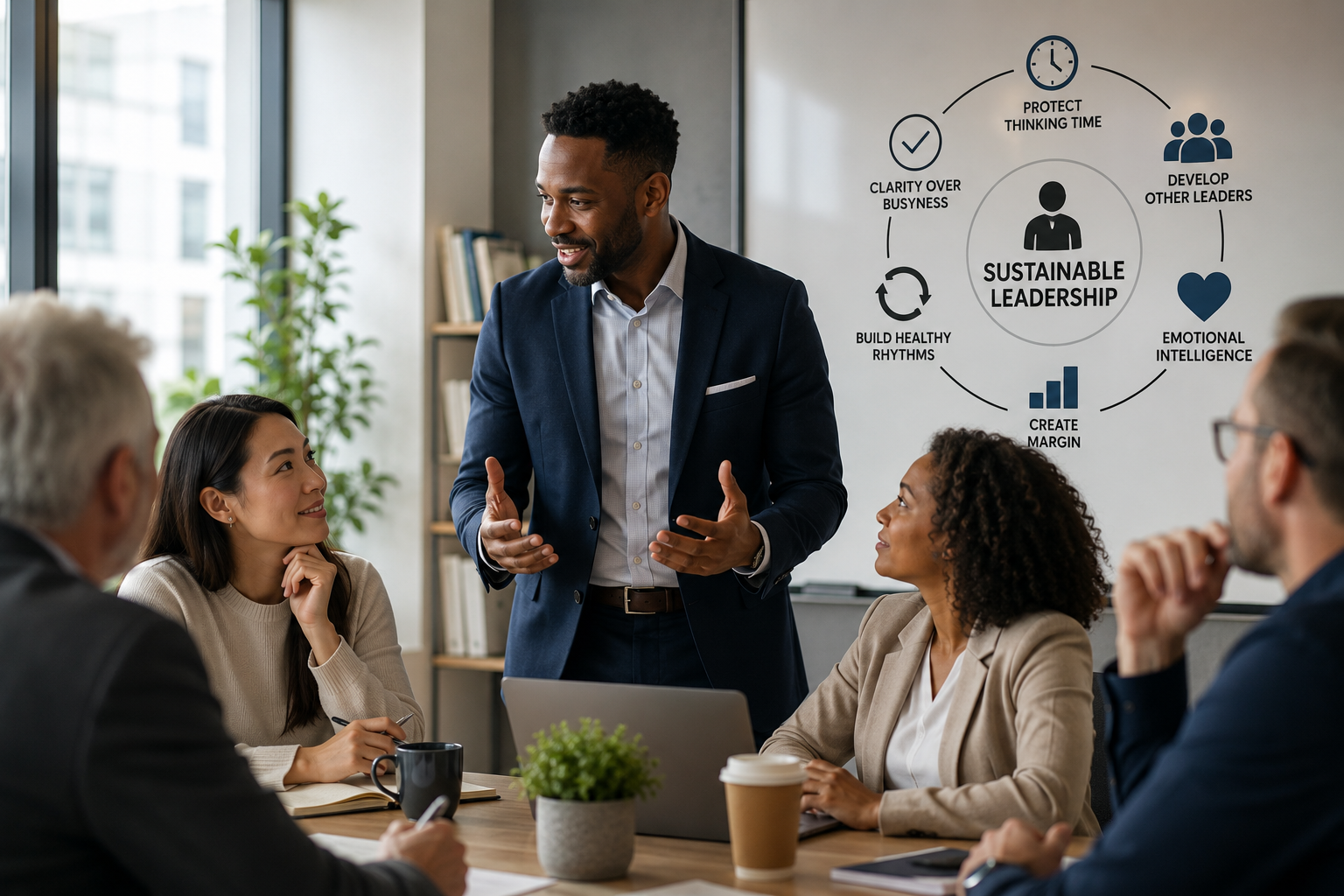
The Sustainable Leader Framework
Throughout my work with organizations, I have found that sustainable leaders consistently practice several disciplines that separate them from leaders who simply survive.
They Create Margin
They intentionally leave space in their calendars for strategic thinking, unexpected challenges, relationship building, and recovery. Margin prevents urgency from replacing wisdom.
They Develop Other Leaders
Rather than becoming indispensable, they intentionally make others more capable. Leadership becomes stronger because responsibility is shared across the organization.
They Protect Deep Thinking
They understand that vision rarely appears during nonstop activity. Strategic clarity requires uninterrupted reflection.
They Prioritize Clarity Over Busyness
Busy leaders complete tasks.
Clear leaders build momentum.
Every meeting, decision, initiative, and conversation aligns with a larger organizational vision.
They Build Healthy Organizational Rhythms
They establish repeatable systems that support sustainable excellence rather than temporary bursts of performance. Teams understand expectations because healthy habits become cultural norms.
They Model Sustainable Excellence
Perhaps most importantly, they demonstrate that success does not require constant exhaustion.
Their teams learn that excellence and well-being can coexist.
That example becomes part of the organization’s legacy.
Frequently Asked Questions
Sustainable leadership sounds simple, but implementing it often raises important questions. Below are several questions I hear regularly from executives, managers, and organizations seeking long-term leadership effectiveness.
What is sustainable leadership?
Sustainable leadership is an approach that helps leaders maintain high performance over the long term by protecting their physical, emotional, relational, and strategic capacity. Instead of relying on constant intensity, sustainable leaders intentionally create systems, rhythms, and cultures that generate lasting momentum for both themselves and their organizations.
Can organizations improve performance while encouraging healthier leadership?
Absolutely. In many cases, healthier leadership actually improves organizational performance. Leaders who recover well make better decisions, communicate more clearly, delegate more effectively, and build stronger teams. Those improvements often lead to higher engagement, greater innovation, improved retention, and more consistent execution.
How can executive coaching support sustainable leadership?
Executive coaching helps leaders recognize blind spots, improve decision-making, strengthen emotional intelligence, clarify priorities, and build healthier leadership habits. Coaching creates accountability while providing practical tools that help leaders move beyond reactive management toward intentional, sustainable influence.
What are the first signs that leadership is becoming unsustainable?
Common indicators include constant fatigue, difficulty concentrating, emotional reactivity, declining creativity, increased micromanagement, delayed decision-making, strained relationships, and feeling perpetually busy without making meaningful progress. Recognizing these signs early allows leaders to make healthy adjustments before burnout affects organizational performance.
Lead With Clarity. Partner With Me.
Healthy organizations do not happen by accident. They are built by leaders who intentionally create clarity, develop people, and establish cultures where sustainable excellence becomes the standard. That is the work I am passionate about every day. As the Founder and Director of Vision Clarity Consulting, I help organizations move beyond temporary motivation and build leadership systems that create lasting momentum.
Whether your organization is investing in executive coaching, leadership development programs, strategic leadership training, or searching for a leadership keynote speaker who will challenge your team to think differently, I bring more than ideas. I bring practical frameworks, real leadership experience, and actionable strategies that help leaders build healthier organizations.
Drawing from more than 15 years of organizational and pastoral leadership, I equip executives, managers, and emerging leaders to cut through complexity, strengthen trust, improve engagement, and lead with greater confidence and clarity. My presentations and coaching sessions are designed to help organizations create leaders who inspire sustainable growth rather than temporary performance.
If your organization is ready to develop healthy leaders who build healthy organizations, I would love to partner with you. Visit the Book Seth page to schedule a keynote, leadership workshop, or executive coaching engagement, or reach out directly at seth@sethyelorda.com. Together, we can build leaders who do not merely survive today’s challenges but create organizations that thrive for generations.